
My story
They found my thymoma before I had a single MG symptom.
A few things nobody tells you before your immune system decides to attack — a.k.a. reinvent itself.
 willuMGwithme.com
Normally it's the other way around: symptoms first, thymoma discovered later, the "oh, that explains it" moment. Mine skipped the line. I met my neurologist for a disease I didn't have yet. My AChR test was 400x normal, but no symptoms. Very on-brand for someone whose diagnosis would go on to be called atypical more times than I can count.
Then the eye drooped. And instead of thinking medical event, I thought did I do this? I genuinely wondered if I'd manifested my own eyelid into submission through sheer anxiety. Turns out no, my body was just getting started, and it had zero interest in my theories.
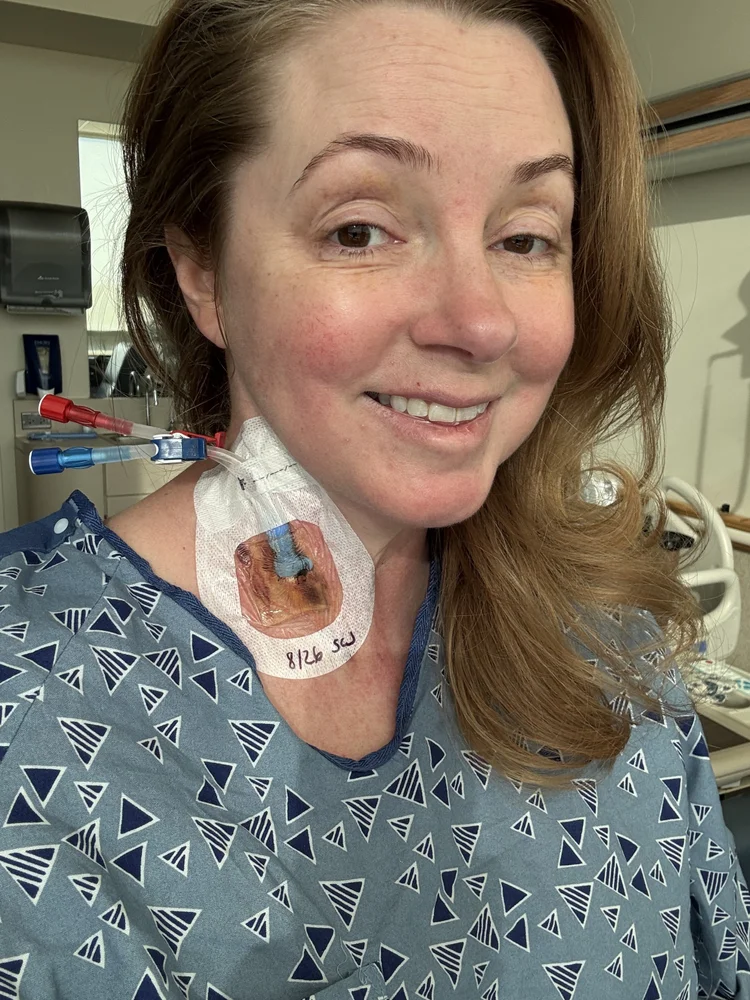
I've always called myself an overachiever. Type A, gold star, the whole thing. Come to find out, my antibodies took that identity and ran with it. Every textbook MG crisis symptom arrived in less than 3 weeks, like my body decided subtlety was for other diagnoses. Eyes that stayed down and never came back up. Double vision. Shallow breathing and choking episodes. And then a night in the ICU where I simply stopped being able to breathe on my own, and a nurse practitioner had to manually bag me, squeezing air into my lungs by hand while my brain calmly registered, so this is actually happening. A speed of escalation my own doctors hadn't seen before, which is not the kind of unique you want to be told you are from a hospital bed.
I am a mom of five at the height of my career. I am also, as of recently, someone who had to go on medical leave because I physically cannot look at a computer screen without my eyes giving out. I am exhausted in a way I don't think I can fully explain to anyone who hasn't lived it, the kind of tired that sleep does not touch. It feels like I became disabled overnight. One week I was running a household of seven people; the next, I was watching neighbors drop off meal trains for my own family because I could not hold my head up. My neck felt like it was holding a cement block. There has not been a single day since this started where I have felt like my old self. Not one.
Now I am on medicine for my medicines.
Let that sink in.
My husband has taken on the role of caregiver and trigger manager. This is an impossible task living in Georgia with the large family we have. When I want to go for a walk outside, or attend a concert, I have to run it by "the boss." A simple walk through Costco can take it out of me, and he reminds me that I can't compare myself to the previous version.
The pill count alone is enough to make you laugh so you don't cry: rows of bottles, alarms on my phone, a system just to keep the system running. My phone rings with nurses, pharmacies, and scheduling, and instead of MySpace (yes, I'm an elder millennial) MyChart is now one of my most-used apps.
And here is the part nobody prepares you for: I don't always know if it's working. There's no dashboard. No little green checkmark. Some mornings I feel a little more like myself. Most of the day my eyes are still droopy, my vision still splits in two. You would think I could use this time to catch up on shows or books, but all that takes too much work. Writing this now is a struggle with my eyes.
So here is what I would tell you, if you are standing where I was, eye drooping, brain whispering you're probably imagining this. You're not. Don't let anyone, including yourself, talk you out of what your body is telling you. Push for the second opinion. Ask the question again if the first answer didn't sit right. And let people bring you the meal train.
Snowflakes might all look different up close, but none of us are imagining the storm.
What surprised you? I want to hear it.
Tell me the thing nobody told you before your own diagnosis. I'm collecting them.
Share your surprise